
Many traders assume that signing up for a major exchange is a single frictionless step: create a username, click a link, and you’re trading. That’s the misconception. With OKX — a hybrid platform combining a centralized exchange, Web3 wallet, DeFi hub, NFT marketplace and DEX aggregator — the real work begins at login and verification. How you authenticate, what identity checks you complete, and whether you use custodial or non-custodial flows determine what products you can access, how quickly you can withdraw, and how much risk you bear.
This article walks through the mechanics of logging into an OKX account in the US context, the verification (KYC) process and the trading consequences of each choice. I’ll compare three common entry paths (basic unverified access, full KYC, and Web3 self-custodial wallet integration), highlight failure modes to watch for, and give concrete heuristics you can reuse when deciding whether to trade spot, margin, or derivatives on OKX.
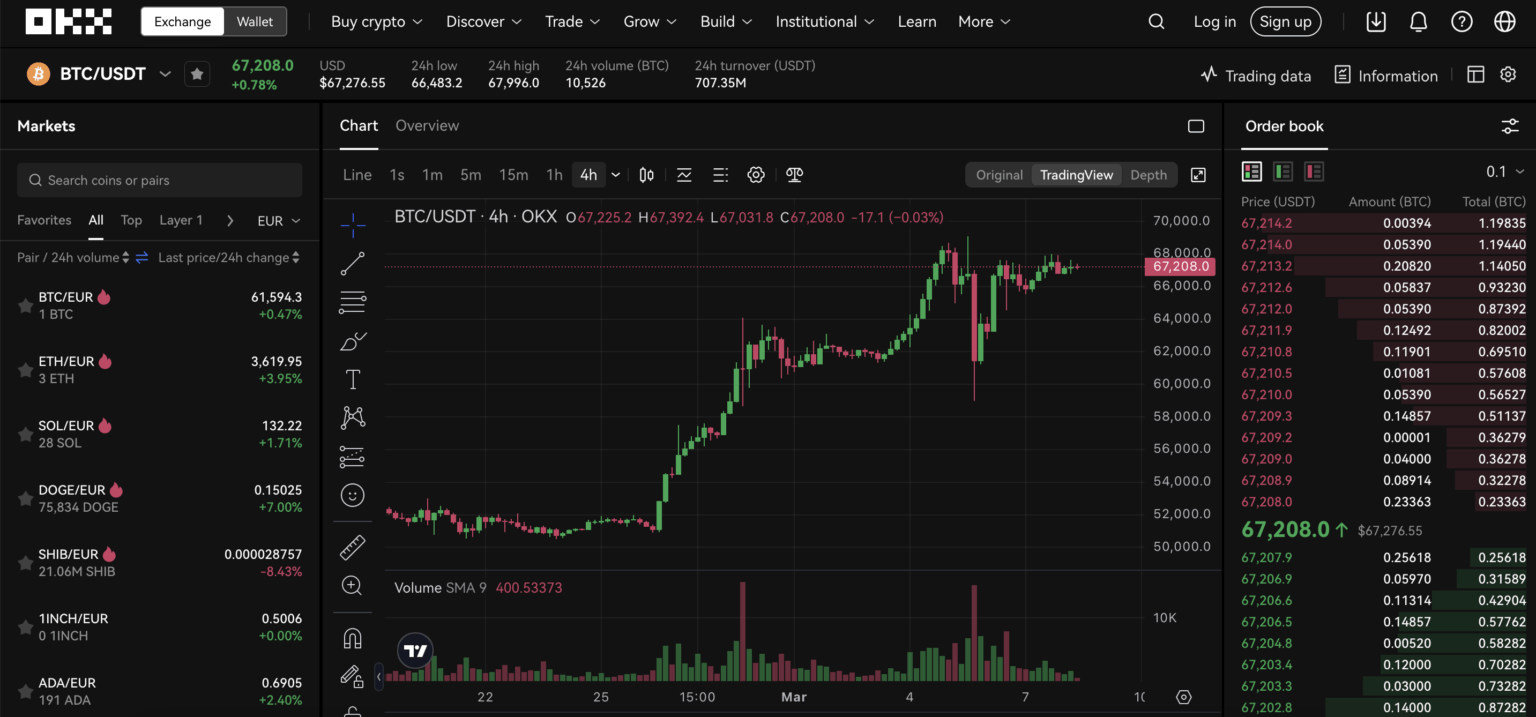
How OKX login and account protection actually work
At a technical level, OKX uses multiple overlapping protections. Accounts are encrypted with industry-grade (described as military-grade in vendor material) encryption, and the platform applies AI-driven monitoring to flag suspicious sessions in real time. Two-Factor Authentication (2FA) is mandatory: you can choose SMS, an authenticator app like Google Authenticator, or biometric methods on the mobile app. Biometric login is convenient on iOS/Android but remember: convenience trades off with portability — a biometric lock on a single device can complicate account recovery if that device is lost.
If you’re logging in for the first time or from a new device, expect stepped-up checks: device fingerprinting plus a one-time code. For many US users, the smoothest path is to enable a hardware-backed authenticator (eg, a YubiKey-like solution where supported) and keep a separate, secure copy of recovery codes. If you prefer, detailed login instructions and the direct web entry point for the platform are available at this OKX entry page: okx login.
Verification (KYC): what it unlocks, and where it constrains you
In the US regulatory environment, KYC is not optional if you want full access. OKX requires a government-issued ID and a facial-recognition liveness check to complete KYC. The immediate consequence is transactional: verified accounts typically get higher deposit/withdrawal limits, access to derivatives and margin products, and fewer friction points during fiat on-ramps and withdrawals. Unverified accounts — or accounts that delay KYC — can be limited to minimal spot trading, lower withdrawal caps, or frozen access when suspicious activity is detected.
There are trade-offs. KYC provides compliance benefits and reduces fraud risk for the exchange, but it also increases the personal data footprint. For users prioritizing privacy, OKX’s non-custodial Web3 wallet is an alternative: you retain private keys and interact with DApps directly. However, that path transfers custody risk to you — lose the seed phrase and recovery is impossible. Decide which risk you prefer to manage: regulatory friction and data exposure with custodial convenience, or self-custody’s permanent-responsibility model.
Which account type fits which trader? A short decision framework
Think in three buckets.
1) Convenience-first active traders: full KYC and custodial exchange account. If you trade spot, use staking, or want fast fiat rails and derivatives (leveraged futures up to 125x on certain markets), this is the pragmatic choice. The exchange’s Proof of Reserves feature gives an extra transparency signal that deposits are backed 1:1, and cold storage (95%+ of assets) and multi-sig withdrawal approvals are structural protections.
2) Privacy or self-custody enthusiasts: non-custodial Web3 wallet integration. Use this if you interact heavily with DeFi, prefer hardware wallet integrations (Ledger, Trezor supported), or want to mint and trade NFTs across multiple chains. Be rigorous about seed phrase management; the safety boundary is binary — a lost seed phrase usually means permanent loss.
3) Low-commitment or exploratory users: minimal signup, postpone KYC. This lets you explore spot markets and learn interfaces, but expect tight withdrawal limits and blocked access to margin/derivatives. It’s a useful staging ground but not a long-term strategy if you plan active trading.
Trading mechanics: how verification status affects what you can do
Verification isn't just administrative — it changes the set of available instruments. Full KYC unlocks margin trading (up to 10x leverage), futures, options, and perpetual swaps (with up to 125x leverage on specific assets), subject to eligibility and risk checks. If you skip verification you should assume derivatives will be unavailable and margin will be restricted or disabled. That restriction matters: leverage amplifies returns and losses; with derivatives available you must manage margin, funding rates, and liquidation mechanics — all of which demand stricter risk controls and a different mental model than spot trading.
Additionally, OKX’s breadth of supported blockchains (130+ native chains) and over 300 assets creates both opportunity and friction. Cross-chain swaps via the DEX aggregator can find better routes, but low-liquidity tokens have wide spreads and slippage risk. If your objective is speculative alpha on thinly traded tokens, be explicit about slippage assumptions and test orders with small sizes first.
Common failure modes and how to prevent them
Phishing and social-engineering are the most common operational failures. Never share 2FA codes or upload IDs to links received in unsolicited messages. OKX’s AI-driven monitoring helps, but it cannot prevent credential theft if you hand over codes. Use a password manager, enable hardware-backed 2FA where possible, and confirm domain names and SSL certificates before entering sensitive data.
Another frequent mistake is conflating custodial and non-custodial security: users assume assets on an exchange are as safe as a hardware wallet. They are not. While OKX stores most assets in cold storage and offers Proof of Reserves, custodial accounts are still subject to platform risk, regulatory actions, and operational failures. For large, long-term holdings, a hybrid approach (keep trading capital on the exchange, store reserves offline in a hardware wallet) is a common risk-management heuristic.
What to watch next: monitoring signals and near-term implications
Three signals matter for US traders moving forward. First, regulatory clarity: the degree to which US regulators press exchanges on listing standards and custody obligations will affect product availability and compliance friction. Second, liquidity trends across layer-2 and cross-chain bridges: OKX’s multi-chain support and DEX aggregator make it nimble, but if cross-chain fragmented liquidity worsens, execution quality on exotic assets could degrade. Third, product shifts: the platform’s continued push into mobile-first experiences (reflected in recent app positioning) means more biometric and device-bound flows—good for convenience, but be ready with device-backed recovery plans.
All of these are conditional. Greater regulatory pressure could push OKX to tighten KYC or restrict certain instruments to US users; improved on-chain bridges could lower slippage and make cross-chain strategies more reliable. Monitor announcements, platform change logs, and liquidity on the assets you trade.
FAQ
Do I have to complete KYC to start trading on OKX from the US?
No — you can create an account and perform limited spot trading without full KYC, but you will face withdrawal limits and cannot access margin or derivatives until you complete identity verification.
Is my OKX account safe if I use biometric login on my phone?
Biometrics add convenience and device-level protection, but they are tied to that device. Combine biometrics with a hardware-backed authenticator or secure recovery codes to protect against device loss. Remember that convenience increases some operational risk if you don't maintain backups.
What happens if I lose access to my non-custodial OKX Web3 wallet?
If you lose the seed phrase for a non-custodial wallet, recovery is virtually impossible. That is the core security trade-off of self-custody: total control in exchange for absolute responsibility.
How does Proof of Reserves affect my trust in OKX?
Proof of Reserves improves transparency by letting users verify that on-chain balances match reported customer liabilities, which reduces counterparty worry. It’s not a substitute for understanding custody models, insurance, or regulatory protections, but it’s a constructive signal.
Final takeaway: treat the OKX login and verification sequence as a choice architecture that shapes every subsequent trading decision. Your authentication method influences recovery options; your KYC choice determines product access; and your custody model defines who bears the tail risk. Make those choices deliberately. Start small, test withdrawals, confirm 2FA and recovery flows, and map each product you plan to use back to the specific security and regulatory conditions that enable it.
